

Long distance relationships: language gap nobody talks about
Long distance relationships, language barrier, cross-language couples, real-time message translation, voice translation
You get a text from your partner. It's short. The words are fine, technically. But you read it three times and still don't know how they meant it.
Were they annoyed? Tired? Just busy?
Now imagine the message arrived in a language you're still learning. The words are translated, but something always goes missing. You can't tell if the flatness is the translation — or them.
Everyone has advice for long distance relationships. Schedule calls. Trust each other. Don't let the time zone win. But almost nobody talks about what happens when you're navigating distance and a language barrier at the same time.

The advice that doesn't fit
Standard LDR advice assumes something quietly: that you and your partner speak the same language, fluently, with all the shortcuts and inside jokes that fluency gives you.
It assumes you can fire off a text without checking a dictionary. That you can call after a bad day and ramble without editing yourself. That you can fight, apologize, and make up using words that feel like yours.
For couples who don't share a first language, none of that holds.
Every message is a small project. You draft, translate, re-read, second-guess, and send — still unsure. A five-minute conversation takes twenty. Jokes that rely on timing or wordplay don't survive the trip. And on the hard days, when you most need to be understood, the gap between what you feel and what you can say widens into something that hurts.
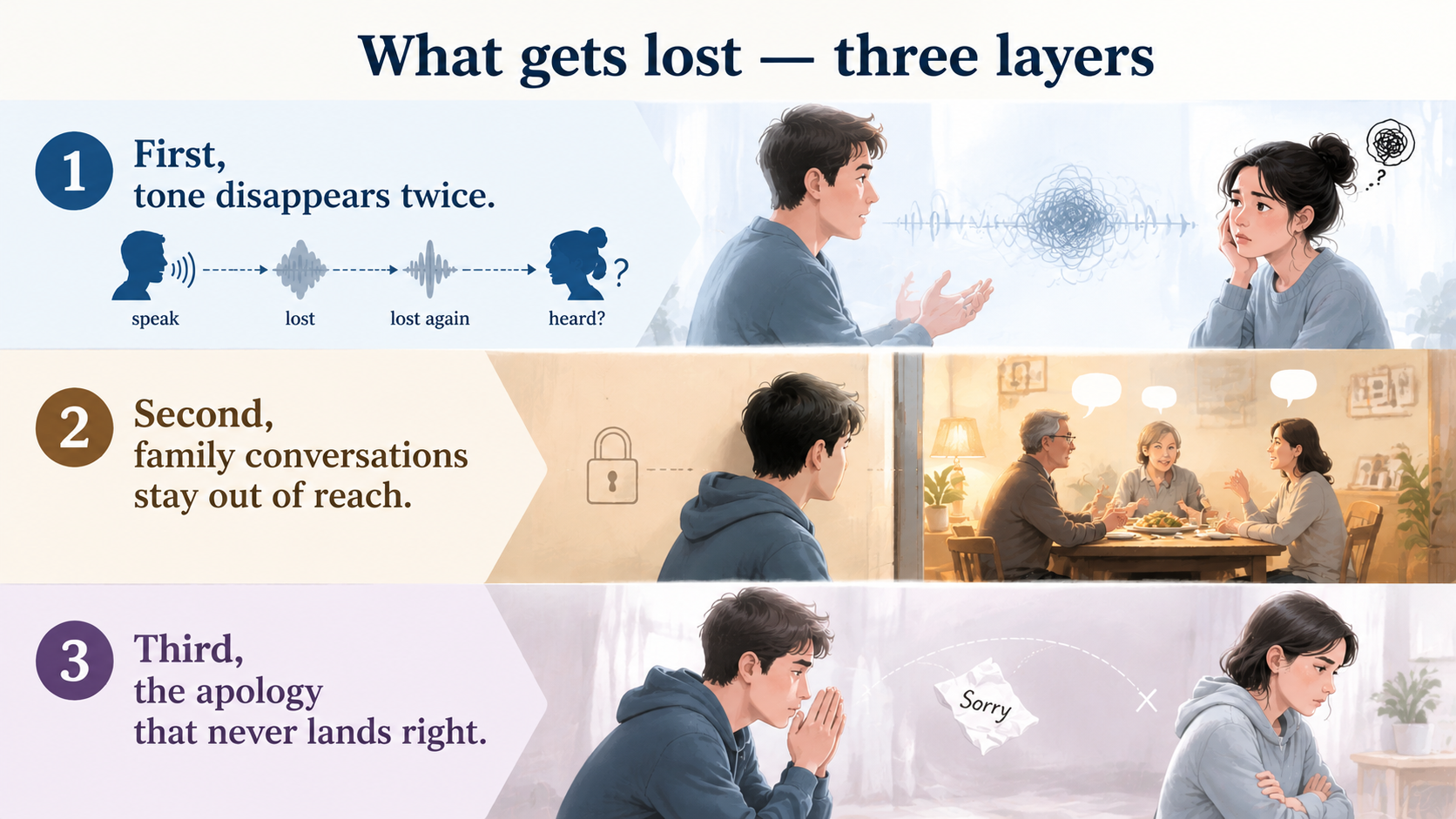
What gets lost — three layers
There's a particular exhaustion that comes with cross-language love. It's not dramatic. It's daily. It shows up in three ways most advice never names.
First, tone disappears twice. Text already strips away tone — everyone knows that. But when you add translation, it strips away a second layer. Your partner's voice, their rhythm, the way they pause or speed up or soften — all of it flattened into neutral, correct sentences that could belong to anyone. You're not just missing their face. You're missing the sound of them.
Second, family conversations stay out of reach. Your partner wants to talk to your parents. Your parents want to know them. But without a shared language, every interaction runs through you. You're not a partner in those moments — you're an interpreter. And no matter how fast you translate, someone is always standing outside the circle.
Third, the apology that never lands right. Every couple fights. But arguing across languages is a skill nobody teaches. You reach for the right word and find a close one — close enough to be understood, but wrong enough to sting. Reconciliation takes longer. Silence fills the space where a familiar phrase should go. You both want to fix it, but the tools feel blunt.
These aren't failures of love. They're failures of the tools most couples have.
What actually helps
So what do couples do?
Some go all-in on language learning. It helps, slowly. But fluency takes years, and your relationship is happening now.
Some develop a shared shorthand — a mix of both languages, emojis, inside references that translate across cultures. This works better than it sounds. When you can't rely on words alone, you build a private language together. That's intimacy, not compromise.
And some find tools that carry the weight for them.
There are apps now that translate messages in real time — you type in your language, your partner reads in theirs. Not a separate translation app you copy-paste into. Just the chat, working the way you wish every chat worked. This is exactly what real-time message translation is built for.
Some of them go further. When you send a voice message, your partner hears it in their language — but in your voice. The tone, the warmth, the way you laugh through a sentence — those things survive. Voice translation that keeps your own voice turns out to change how a message lands: hearing someone's real voice, even through translation, matters more than we expect.
That's not a small thing. When you've spent months or years reading your partner's words through the flat filter of a translator, hearing them speak — really speak, in a voice that sounds like them — feels like coming up for air.
These tools don't replace learning each other's languages. They don't need to. They just make sure that while you're learning, while you're apart, while you're doing the hard daily work of loving someone across every kind of distance — the words between you don't get in the way. (If you're navigating this together, our guide for cross-language couples goes deeper on the daily habits that help.)
What doesn't help
Skip the advice that tells you to "just communicate better." You're already communicating more than most couples ever do — just with a heavier backpack. The goal isn't more effort. It's better tools and gentler expectations.
Also skip the idea that technology makes things cold. A handwritten letter is romantic. So is hearing your partner's voice in your language at the end of a long day, without either of you having to edit yourselves.
FAQ
Does a language barrier make long distance relationships harder? Yes — and not in the way most people assume. The difficulty isn't just translation. It's the loss of tone, the extra time every conversation takes, and the loneliness of being the only person who can bridge two worlds. Couples who name this openly tend to find workarounds faster than those who pretend it isn't there.
Can translation apps replace learning each other's language? No — and they shouldn't try. Learning your partner's language is an act of love. Translation tools are for the in-between moments: a quick message while you're at work, a family group chat where you can't be the interpreter, a voice note when you're too tired to type. Use both. They do different things.
What's the one thing that helps cross-language couples stay close? Voice. Not just calls — but voice messages that carry your real tone. Text alone is a narrow channel. Add translation on top, and too much gets lost. When your partner can hear you, even briefly, the gap narrows.
Distance is hard enough. The language between you doesn't have to be. The couples who make it work aren't the ones who try harder — they're the ones who stop letting the words get in the way.
Related Posts Read next: How cross-language couples build a private language Also see: Voice translation, explained: how it keeps your real voice