Why Cross-Language Chat Still Breaks In AI Free Chat Apps
Introduction
At first glance, modern messaging feels effortless. With a free chat app, people can connect instantly across borders. Text messages, voice notes, emojis, and group chats make communication fast and accessible.
But once language differences enter the conversation, everything changes.
Users copy a message, paste it into a translator, wait for results, copy it back, and send again. The conversation slows down. Tone is lost. Emotion disappears. What should feel natural turns mechanical.
Despite rapid advances in AI and the growing number of free messaging apps, cross-language chat still breaks conversations. The issue is not translation accuracy, but how translation is treated as something separate from the chat itself.
This article explains why most AI free chat apps fail at cross-language communication, what global users actually need, and how embedding translation directly into chat—like Intent does—creates a fundamentally different experience.
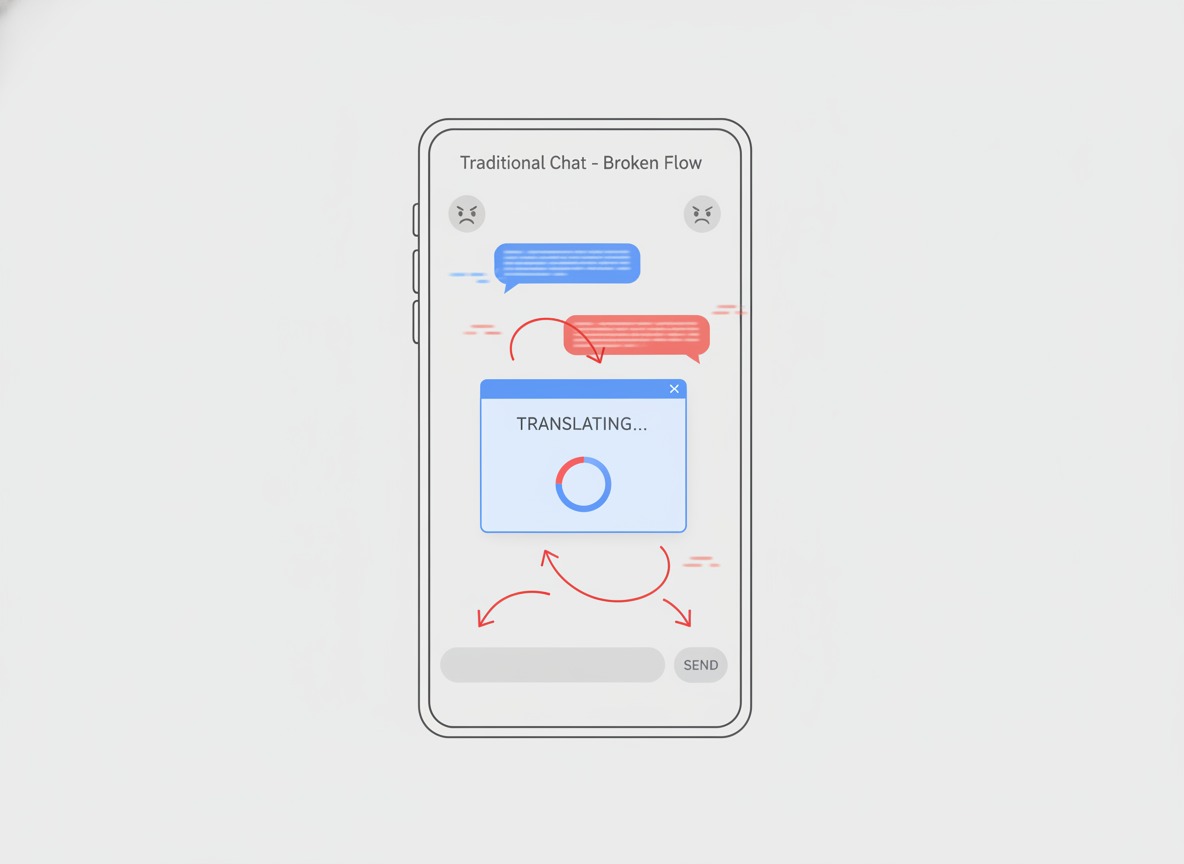
Why Traditional Chat Apps Break Cross-Language Conversations
A free chat app or free text message app is designed for speed and simplicity, not for multilingual communication. Its core assumption is that both users share the same language. Once that assumption breaks, the entire experience begins to fall apart.
Most free text messaging apps treat translation as an add-on rather than a core capability. Users are required to copy messages, rely on external tools, or tap optional translation buttons. This introduces friction at every step and interrupts conversational flow.
As a result, in many free chat apps:
- Translation becomes a manual task
- Conversation rhythm is repeatedly broken
- Emotional nuance is weakened or lost
- Cognitive fatigue increases as users switch between tools
Chatting is not just about exchanging words. It depends on timing, continuity, and emotional presence. When translation happens after a message is sent, that continuity disappears.
This is why cross-language communication feels unnatural in most traditional free group messaging apps. The issue is structural: translation is treated as an extra step instead of being part of the conversation layer itself.
What Global Users Actually Need From a Chat App
Global users do not need “more translation buttons.” They need conversations that feel natural, regardless of language.
Across regions and use cases, the real needs are consistent:
- Translation should happen automatically, not manually
- Language preferences should be set once, not adjusted constantly
- Conversations should remain continuous and uninterrupted
- Emotional tone should survive across languages
- Users should retain control over when and how translation appears
Many products focus on translation accuracy alone. But accuracy without continuity still produces broken conversations. Even highly accurate translations feel disruptive if they interrupt rhythm and attention.
What users actually want from the best chat app is not smarter translation as a feature, but smoother communication as an experience. This is the gap most best AI chat apps fail to address and the space where Intent is designed to operate.
How Intent Redefines the Best AI Chat App Experience
Intent approaches cross-language communication from a fundamentally different direction.
Instead of adding translation to chat, Intent rebuilds chat around translation. As one of the best AI chat apps, Intent treats translation as infrastructure rather than a feature.
With automatic chat translator embedded directly into the chat layer:
- Messages are translated automatically by default
- Each user sees messages in their chosen language the moment they arrive
- Original text is always instantly accessible
- Translation can be turned on or off at any time
This design removes the need for external tools or extra actions. Users no longer think about translation—just simply chat.
Unlike many other apps that prioritize intelligence metrics such as speed or accuracy, Intent, as one of the best AI chat apps prioritizes conversation continuity. The result is a chat app that translates without breaking rhythm or attention.
Intent also integrates live chat translation into voice communication. Instead of replacing voices with synthetic audio, translated voice messages preserve the sender’s vocal identity through voice cloning. Emotional tone, personality, and human presence remain intact across languages. This is what differentiates Intent from other products claiming to be the best chat app for global users: translation works silently in the background while users stay in control.
Why Intent Works for Real Conversations and Group Chats
The advantages of Intent become even clearer in real-world scenarios, especially group conversations. In traditional free group messaging apps, multilingual chats often fragment into language clusters. Important messages are missed, participation becomes uneven, and collaboration slows down.
Intent’s chat translator embedded directly into the chat layer: eliminates these barriers. With translation embedded by default:
- Every participant sees messages in their preferred language
- Language differences never block participation
- Conversation flow remains continuous for the entire group
This makes Intent suitable not only for casual social chats, but also for international families, global communities, and cross-border teams. Because translation happens automatically and consistently, users experience the same conversation, without needing to adjust behavior, simplify language, or disengage.

Conclusion
Cross-language chat still breaks conversations not because translation technology is weak, but because most free chat app experiences were never designed for multilingual communication.
A real solution requires translation to be:
- Automatic
- Embedded
- User-controlled
- Emotionally aware
Intent represents a new category of AI free chat apps, one where language adapts to people, not the other way around. As global communication becomes the norm, real-time translated chat is no longer optional. It is essential.