

AASF international conference, AASF 2026, real-time conference translation, live bilingual captions, real-time transcription, Intent Live Caption
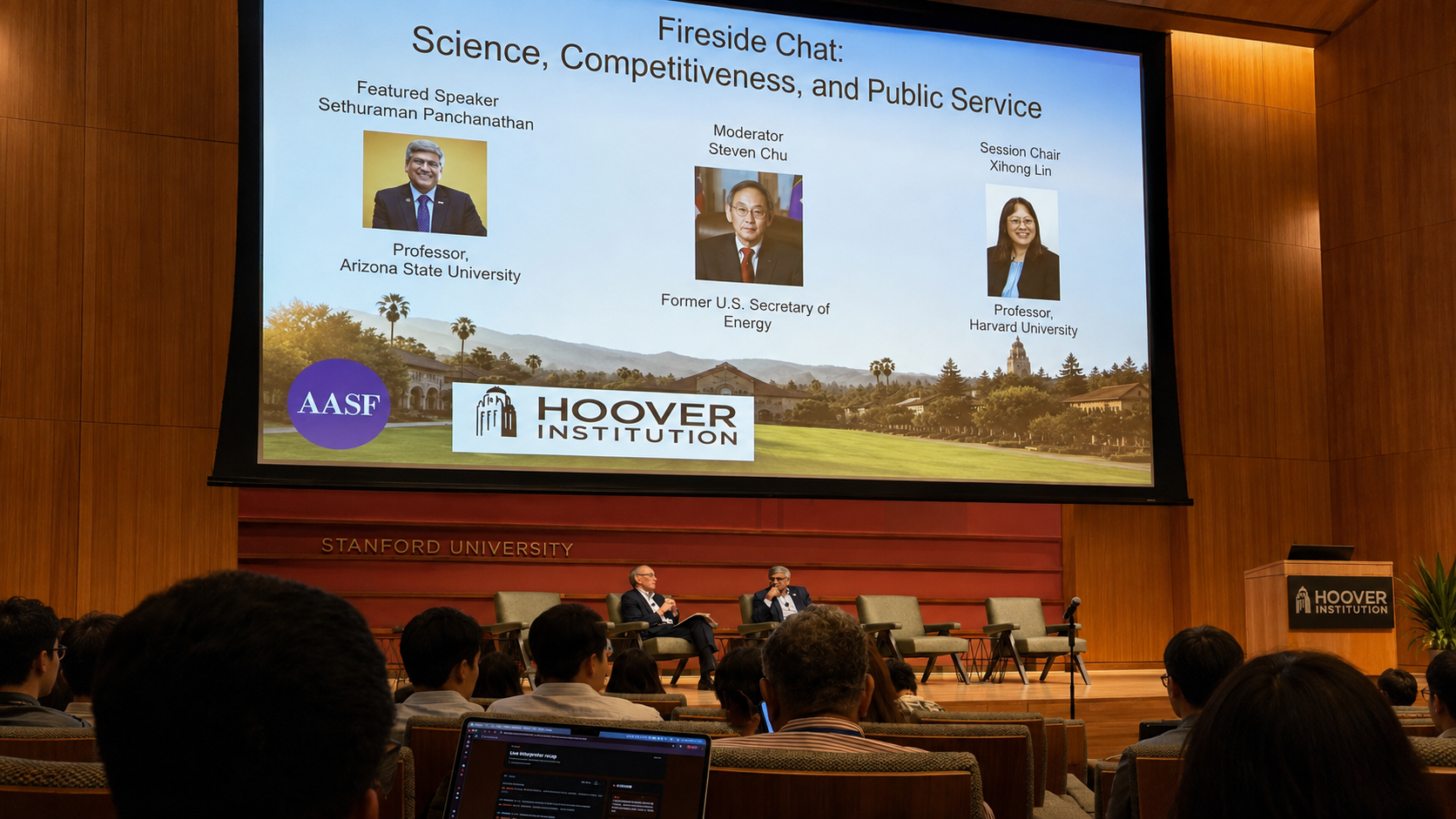
Attending an international conference is not simply about whether you can understand the language being spoken. The real challenge is staying with every idea, technical term, and discussion through hours of back-to-back presentations. For attendees who are not native English speakers, that pressure can be especially noticeable. You may understand most of what is being said, but one unfamiliar term, a fast sentence, or an accent you are less used to can briefly throw you off. By the time you work out what the previous sentence meant, the speaker may already have moved on to the next topic.
From August 7–9, 2026, the AASF International Conference (Asian American Scholar Forum 2026) was held at Stanford University in the United States. According to the official AASF 2026 program, the three-day event included the Frontier Symposium, Pioneer Symposium, and Policy Forum, with discussions spanning artificial intelligence, life sciences, materials and energy, quantum computing, education, scientific innovation, and research policy. Scholars, researchers, technology professionals, and policy experts from different fields and backgrounds gathered in the same space to share research, discuss emerging trends, and exchange ideas.
At AASF 2026, Intent provided a Live Caption web page for attendees to use during the event, and it received positive feedback on site. As presentations took place, spoken audio could be continuously converted into text, with a translation displayed alongside it in the attendee's preferred language. By showing the original and translated text side by side, Live Caption gave attendees a second way to follow the conversation through reading as well as listening. It also gave us the opportunity to see how real-time bilingual captions perform in a real, high-information-density international conference environment.
Image alt: Attendees at the 2026 AASF International Conference using Intent Live Caption to follow real-time bilingual captions.
What was discussed at the 2026 AASF International Conference?
The 2026 AASF annual event ran for three days. The Frontier Symposium took place on August 7, followed by the Pioneer Symposium on August 8, with both events held at Stanford Memorial Auditorium. On August 9, AASF and the Hoover Institution jointly hosted the Policy Forum at Stanford Hauck Auditorium.
The Frontier Symposium focused on the frontiers of science and technology, covering areas such as life sciences, materials and energy, AI infrastructure, quantum computing, and AI in education. For attendees, that meant a presentation on artificial intelligence infrastructure could be followed immediately by a session on quantum computing, energy, or life sciences. Each field comes with its own terminology and knowledge base, so the pace of information switching throughout the conference was extremely fast.
The Pioneer Symposium shifted more attention toward scientists and their long-term contributions, connecting scientific pioneers and research breakthroughs with the development of the next generation of researchers. The Policy Forum then expanded the conversation beyond laboratories and technology itself to issues such as research funding, international talent, scientific collaboration, innovation ecosystems, and public policy.
That is one of the things that makes the AASF International Conference particularly representative of modern global events. It is not built around a single technology topic. Instead, it brings science, technology, talent, and policy into the same conversation. For attendees, three consecutive days of dense, cross-disciplinary content also make one question very practical: how do you keep understanding what is being said without falling behind?
Why language barriers at international conferences are about more than "how good your English is"
It is easy to reduce language challenges at international conferences to English proficiency. In practice, however, even someone who communicates comfortably in everyday English may still find it difficult to follow several hours of technical discussion without interruption.
The first challenge is terminology. At a technology and academic conference like AASF, speakers naturally use field-specific phrases such as AI infrastructure, quantum computing, and research funding. Attendees have to do more than hear the words correctly. They also need to understand what those terms mean in the context of the current discussion. Missing one important concept can make the argument that follows much harder to track.
The second challenge is immediacy. When reading a paper, you can stop and look something up. When watching a foreign-language video, you can pause and replay it. A live conference does not have a pause button. Speakers keep moving forward, while attendees have to listen, interpret ideas, decide what matters, and take notes at the same time. For anyone attending in a second language, that cognitive load can build over the course of the day.
Different speakers can also vary in accent, pace, and language background. You may follow one keynote effortlessly and then need more time to adjust to the next panel discussion. What affects the conference experience is often not a total inability to understand, but small pieces of missing information that accumulate throughout the day.
Live bilingual captions provide another path to the same information. You can keep listening to the speaker, but if you miss a word, name, or number, you can quickly reconnect with the context on screen. To learn more about how this type of captioning works, see What are live bilingual captions? A complete guide.
How was Intent Live Caption used at AASF 2026?
At AASF 2026, Intent provided a Live Caption web page for attendees. Once a user started recording, Intent Live Caption continuously listened to nearby speech, converted each sentence into text in the original language, and displayed a translation alongside it. The system can automatically detect the language being spoken, so attendees do not need to keep changing the source language manually as different speakers take the stage.
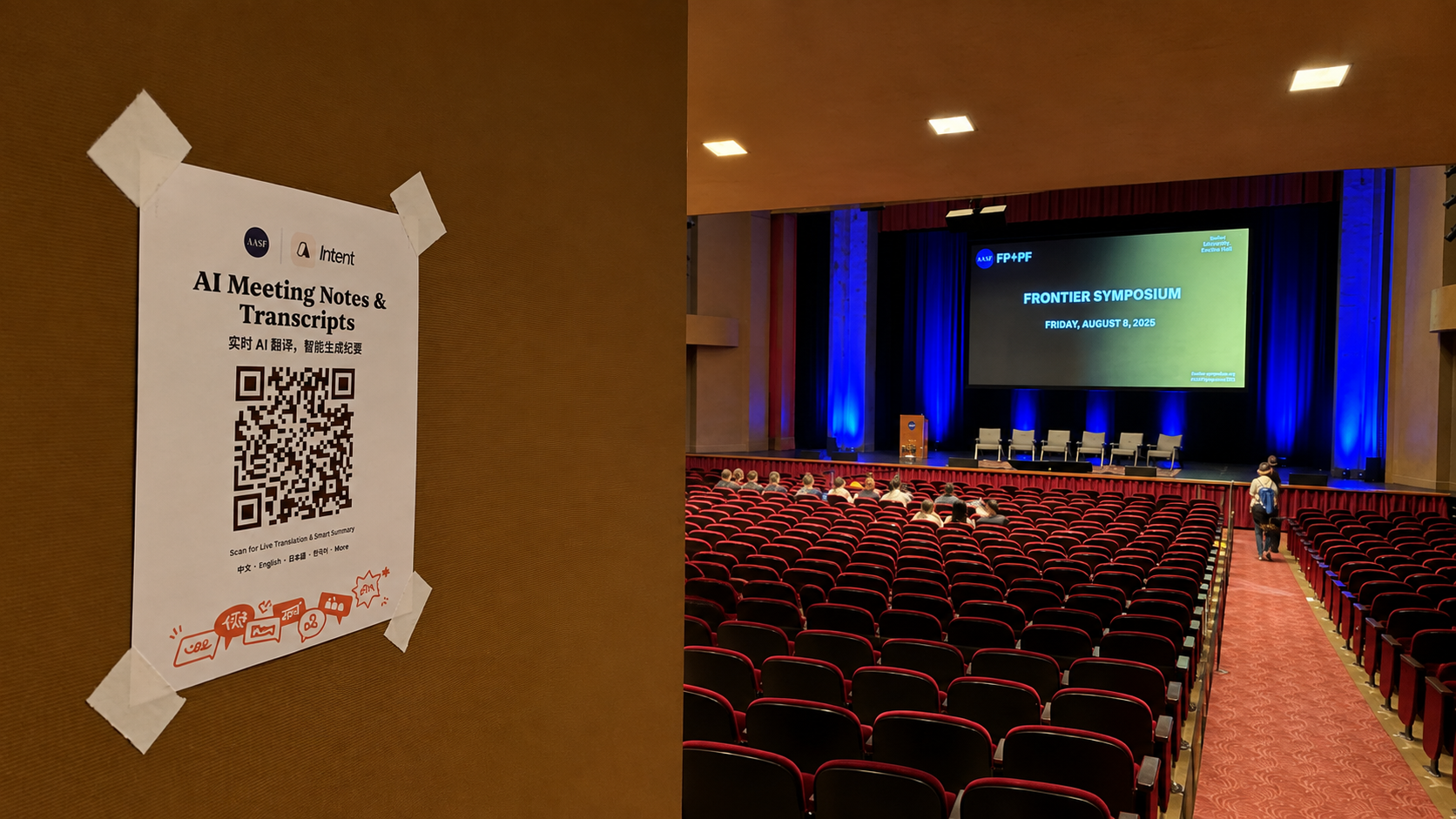
This is different from recording an entire conference session and processing it afterward. Live Caption is designed for the moment while the conversation is still happening. When a speaker quickly introduces a research topic, attendees can listen to the real voice while also reading the captions. If they miss a technical term, they can confirm the original wording immediately. If they briefly lose track of the meaning, the translation can help them reconnect without leaving the session to search for a separate translation.
Showing the original and translation side by side is particularly useful in professional conference settings. The translation helps attendees understand the meaning quickly, while the original preserves names, technical terminology, project titles, and exact phrasing. For example, if a speaker mentions "foundation model," "quantum computing," or the name of a specific research project, seeing only a translated phrase may not be enough for later research. Keeping the English term visible makes it much easier to find the relevant paper, institution, or project after the event.
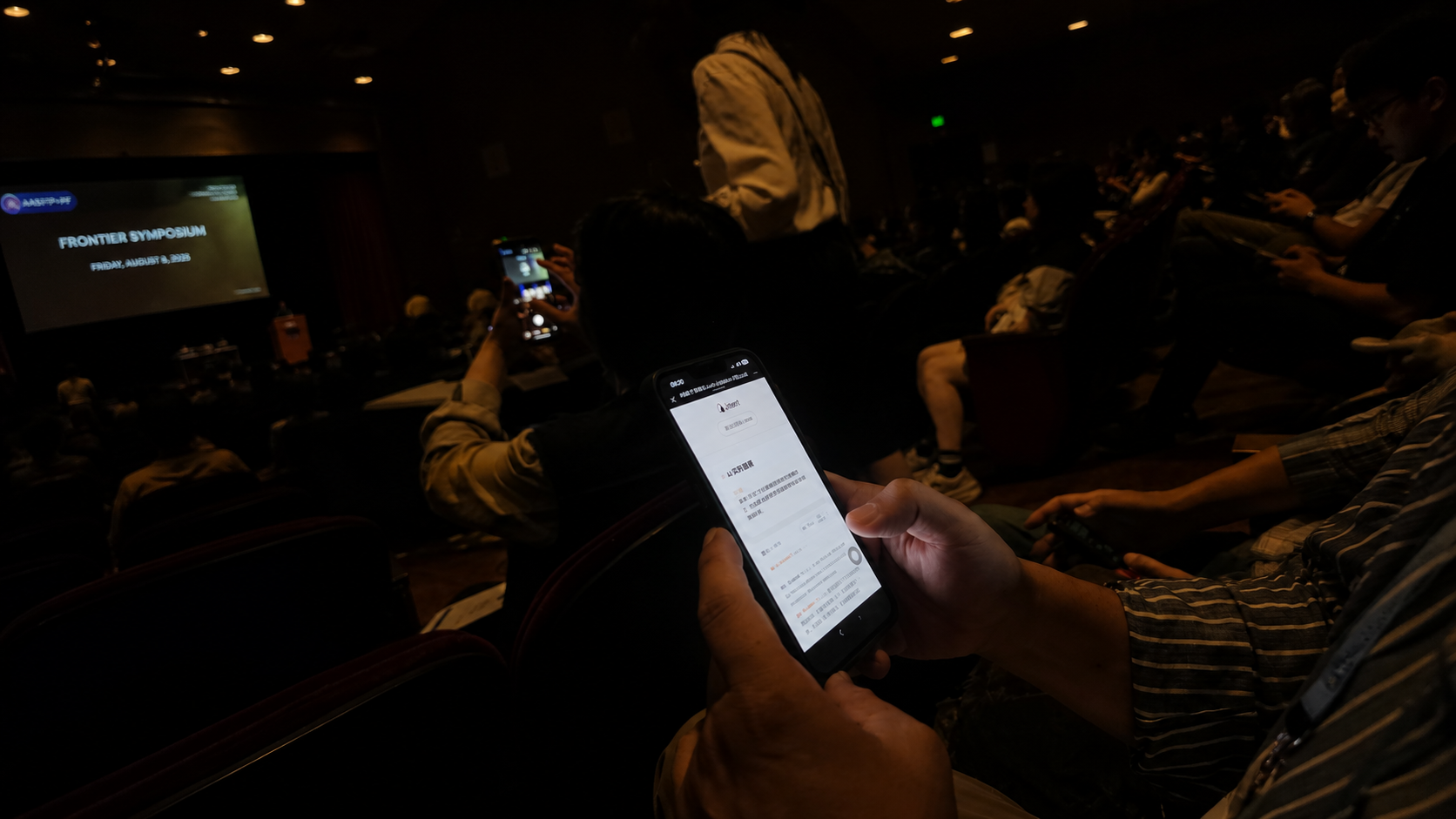
Intent currently supports real-time transcription in 66 languages. In multilingual environments, automatic language detection further reduces the amount of manual setup required. The focus of a conference should remain on the speaker and the conversation in the room. Translation should work quietly in the background rather than making attendees think about which button they need to press next.
What did the feedback from AASF tell us?
For Intent, AASF 2026 was more than a product showcase. It was an opportunity to see how Live Caption performs in a real international conference environment.
In a controlled testing environment, it is possible to verify whether speech can be recognized, captions can appear, and translations can be generated. A real conference is much more complicated. There may be multiple speakers, different accents, specialized terminology, hours of continuous use, and ambient noise in the venue. Most importantly, attendees need to focus on the content itself rather than on figuring out how a translation product works.
Intent Live Caption was used by attendees at the AASF International Conference and received positive on-site feedback. What that feedback helped validate was not simply whether people wanted translation, but whether real-time captions could fit naturally into the flow of a live event.
If a translation tool forces someone to stop listening, copy a sentence, switch apps, choose a language, and then return to the presentation, the translation process itself becomes another distraction. By contrast, when captions update continuously and users can glance at them only when needed, the technology becomes a supporting layer rather than an interruption.
This idea of reducing disruption is also part of the broader shift in how real-time translation is changing cross-border communication. The next step in cross-language communication is not only making individual translations faster. It is reducing the number of extra steps people have to take in order to understand each other.
From understanding the session live to creating bilingual conference notes
Real-time understanding is only one part of the international conference experience. The value of a good conference often continues long after a speaker leaves the stage.
Attendees may want to revisit a point made by a particular speaker, confirm a technical term, organize new research directions, or summarize themes that came up across several panel discussions. Traditional notes can only capture so much, especially when someone is simultaneously listening to, understanding, and taking notes in a second language.
Intent Live Caption keeps the complete transcript after a session ends. Users can review the original and translated text, search for a person, project, or technical concept, and export the text for use in their own conference notes. A presentation that could normally only be heard once can therefore become a bilingual record that is available for later reference.
At an international conference like AASF, that workflow can be especially useful. During the event, live captions help reduce the effort required to keep up. Afterward, the saved transcript helps attendees return to a particular discussion. Live captions answer, "What are they saying now?" The post-session transcript helps answer, "What exactly did they say earlier?"
Image alt: Using an Intent Live Caption transcript after the AASF International Conference to search technical terms and organize bilingual conference notes.
Why show the original and the translation together?
Showing only the translation may seem simpler, but at an international conference, the original and translated text serve different purposes.
The translation helps attendees understand the meaning quickly. When a speaker is moving fast, users do not have to mentally translate every sentence and can keep more of their attention on the presentation itself. The original text is equally important, however, because names, institution names, numbers, abbreviations, and technical terms are not always best understood through translation alone.
If a translation looks unusual, the original also provides something to compare it against. An attendee may recognize a familiar technical term, borrowed word, or proper noun in the source text and immediately understand why the translated sentence reads the way it does.
More importantly, captions do not replace the speaker. Attendees still hear the real voice, tone, pauses, and emphasis. The captions simply provide an additional path to understanding. This is similar to Intent's approach to voice communication, such as translating voice messages without losing the sender's voice. The goal of the technology is not to erase language differences, but to make people easier to understand while preserving the original communication.
How are live captions different from professional interpretation?
Live Caption and professional interpretation are not interchangeable in every situation.
Professional interpreters can take context, diplomatic wording, humor, cultural differences, and specialized subject knowledge into account. In legal proceedings, medical conversations, formal negotiations, and other high-stakes settings where accuracy and accountability are critical, trained language professionals may still be necessary.
Live bilingual captions are better understood as immediate reading support. They can help users follow international conferences, classes, lectures, workshops, business discussions, and videos, while also leaving behind a transcript that can be searched later.
For information that directly affects important decisions, such as financial amounts, legal obligations, final project deadlines, or formal commitments, the wording should still be confirmed with the relevant people even if the captions appear clear. Live captions can reduce uncertainty, but they do not remove the need for human verification when the stakes are high.
Where else are live bilingual captions useful?
International academic conferences
AASF is a strong example of where live captions can be useful, but the same challenges appear at many other international academic conferences. Keynotes, panel discussions, workshops, and roundtables often run back to back, requiring researchers to absorb a large amount of specialized information in a short period of time. Even attendees with strong foreign-language skills may feel the additional cognitive load of listening in a second language for hours at a time.
Live captions can provide support when someone misses a technical term, number, or proper noun, while keeping the original text visible for later research. For people attending several sessions in one day, the saved transcript can also become a useful reference when preparing a conference summary afterward.
Cross-border business meetings
International teams often choose a shared working language, but that does not mean everyone processes that language at the same speed. The biggest misunderstandings are often not about the overall direction of a meeting, but about details such as product names, numbers, deadlines, ownership, and next steps.
Live captions can help team members confirm information while the discussion is happening and revisit the context afterward. For global teams, this mirrors the broader shift toward real-time multilingual translation in global chats, where translation is increasingly becoming part of the conversation itself rather than something used afterward to repair misunderstandings.
Classes and lectures abroad
In a class taught in another language, students may understand the main concept but miss the spelling of a technical term, a number, or an assignment detail because the instructor is speaking quickly.
Live Caption can help students listen while also checking the original and translated text. After class, the full transcript can become a searchable bilingual study record for looking up terminology and organizing notes. It should support the instructor's official course materials rather than replace them.
Trade shows and international industry events
International trade shows can be even more complex than a conference auditorium. The environment may be noisy, conversations are often short, and company names, product specifications, prices, and next steps come up frequently. A visitor may speak English with one exhibitor in the morning and another language with a different team later that afternoon.
In this kind of constantly changing language environment, automatic language detection can reduce the need to change settings manually. If important information also appears on product labels, brochures, or technical drawings, an AI image translator for technical drawings and product labels can cover the written information that speech translation does not.
How to use Live Caption effectively at an international conference
Before a session begins, place the device where it can clearly pick up the main audio source and reduce background noise where possible. If the event involves recording or transcription, attendees should also confirm the organizer's rules and make sure the people involved are aware when required.
During the session, captions work best as a second information path rather than a complete replacement for listening. Continue paying attention to the speaker's tone, context, and presentation materials, and use the captions when you need to confirm something you did not hear clearly. This is generally more natural than staring at the text continuously.
After the session, use the transcript to search for the parts that actually matter, such as a speaker's name, a research topic, a technology, or a key conclusion. Names, numbers, technical terminology, and wording related to important decisions should still be reviewed rather than assuming that every automatically transcribed line is perfect.
What affects live caption accuracy?
Speech recognition generally works best when the audio is clear, the speaker is reasonably close to the device, and one person is speaking at a time. At international conferences, several factors can affect caption accuracy, including overlapping conversations, venue noise, distant speakers, internal abbreviations, uncommon names, and highly specialized terminology.
When a piece of information will directly affect what happens next, it is worth confirming it. If a speaker mentions an unfamiliar project name, the original caption can help you search for it afterward. If the discussion involves a financial amount, date, or project commitment, it should be checked against the actual speaker or official conference materials.
The purpose of Live Caption is to reduce uncertainty caused by language, not to remove the need for judgment.
Privacy and consent still matter
International conferences, classes, and face-to-face conversations may include personal information, unpublished research, or commercially sensitive content. Real-time captions do not mean every situation should automatically be recorded.
Before using transcription, check the event's rules, your school or company's policies, and any recording requirements that apply in the location where you are using it. If the content is confidential, confirm that transcription tools are permitted before starting a session.
Intent's current Privacy Policy explains how translation, transcription, and related features process content. To learn more about privacy in cross-border communication, you can also read Privacy in international chat apps: what to know before you send.
Clear notice and consent are themselves part of good cross-language communication.
What AASF tells us about the next stage of cross-language communication
Many of the topics discussed at AASF 2026 — artificial intelligence, life sciences, energy, quantum computing, and research policy — increasingly depend on collaboration across institutions, disciplines, and countries. Knowledge already moves globally, but participating in global conversations should not require everyone to have exactly the same language background.
A researcher may have deep expertise in a subject while still needing extra effort to process a second language. A student may fully understand a course concept but miss details because an instructor is speaking quickly. A cross-border team may repeatedly confirm information because people are working across different languages.
Translation products may therefore become less like separate tools that people have to stop and open, and more like a natural layer within communication itself. When speech happens, text appears. When the language changes, a translation appears alongside it. When the meeting ends, the information remains searchable.
The use of Intent Live Caption at the AASF International Conference gave us a clearer view of that future. The real value of real-time translation is not in constantly reminding attendees that technology is working. It is in allowing them to return their attention to the ideas on stage, the questions being discussed, and the conversations they actually want to join.
FAQ
What is the AASF International Conference?
AASF stands for Asian American Scholar Forum. The 2026 annual event was held at Stanford University from August 7–9 and included the Frontier Symposium, Pioneer Symposium, and Policy Forum, with discussions spanning science, technology, education, innovation, and research policy.
What did Intent provide at AASF 2026?
Intent provided a Live Caption web page for attendees at the AASF International Conference. Spoken audio could be transcribed in real time while a translation appeared alongside it, allowing attendees from different language backgrounds to follow bilingual captions as they listened. The on-site use received positive feedback.
How many languages does Intent Live Caption support?
Intent supports real-time transcription in 66 languages. Live Caption can also detect the language being spoken automatically, reducing the need to change the source language manually in multilingual conversations.
Can I see the original and translated text together?
Yes. The original spoken-language text and the translation in your preferred language appear side by side. The translation helps you understand the meaning quickly, while the original can help you verify names, technical terms, numbers, and exact wording.
Can I access the captions after the conference session ends?
Yes. Intent keeps the complete transcript so users can review, search, and export it afterward for conference notes or later study.
Can Live Caption completely replace a professional interpreter?
Not in every situation. Real-time captions can be useful for international conferences, classes, everyday business discussions, and lectures, but legal, medical, formal negotiation, and other high-stakes settings may still require a qualified professional interpreter.
Should I tell other people before using Live Caption?
That depends on the setting. Recording and transcription may be subject to event rules, company policies, school requirements, and local laws. When consent is required, participants should be informed before recording or transcription begins.
Let language stop deciding how much you take away from a conference
The real value of an international conference comes from hearing new ideas, discovering new areas of research, and connecting with people from different backgrounds. If too much attention is spent simply trying to keep up with the language, the most important information can be easier to miss.
At AASF 2026, Intent Live Caption was used in a real, information-dense international conference environment. Attendees could listen to presentations while following the original and translated text, then search, review, and export the transcript afterward.
Live bilingual captions connect "understanding what is happening now" with "returning to the information later." A presentation that would normally be heard only once can become a searchable bilingual conference record, and an important idea does not have to disappear simply because someone briefly missed it in another language.
Languages can be different. Important information should not be lost because of them.
Related reading